HuHu AI: Can an AI Try-On Studio Replace the Fashion Photoshoot?
By: AI Collection
At a glance

HuHu AI
PaidA mid-size apparel brand can burn a week and a few thousand dollars getting one collection in front of a camera: book the studio, hire models, style the looks, shoot, retouch, repeat for every colorway. Multiply that across hundreds of SKUs a month and product photography stops being a creative exercise and becomes a logistics bottleneck. HuHu AI is built squarely at that bottleneck. It bills itself as an "AI Visual Content Creator for High-Converting Ecommerce" — feed it a flat garment shot and it returns an on-model photo, no camera or crew involved.

It's a crowded idea, so the useful question isn't "does AI try-on exist?" but "is this particular tool good enough to put in a real catalog?" Here's what the product actually offers, what it costs, and where the seams show.
What HuHu actually does
Stripped of marketing language, HuHu's own help center describes it as a platform that "transforms garment images into lifestyle photos without traditional photoshoots." The core is Virtual Try-On: you upload a single garment image — front, back, or side, and it works from flat lays, hanger shots, ghost mannequins, or existing model photos — and HuHu generates on-model visuals, reproducing stitching, seams, and patterns on the model you pick.
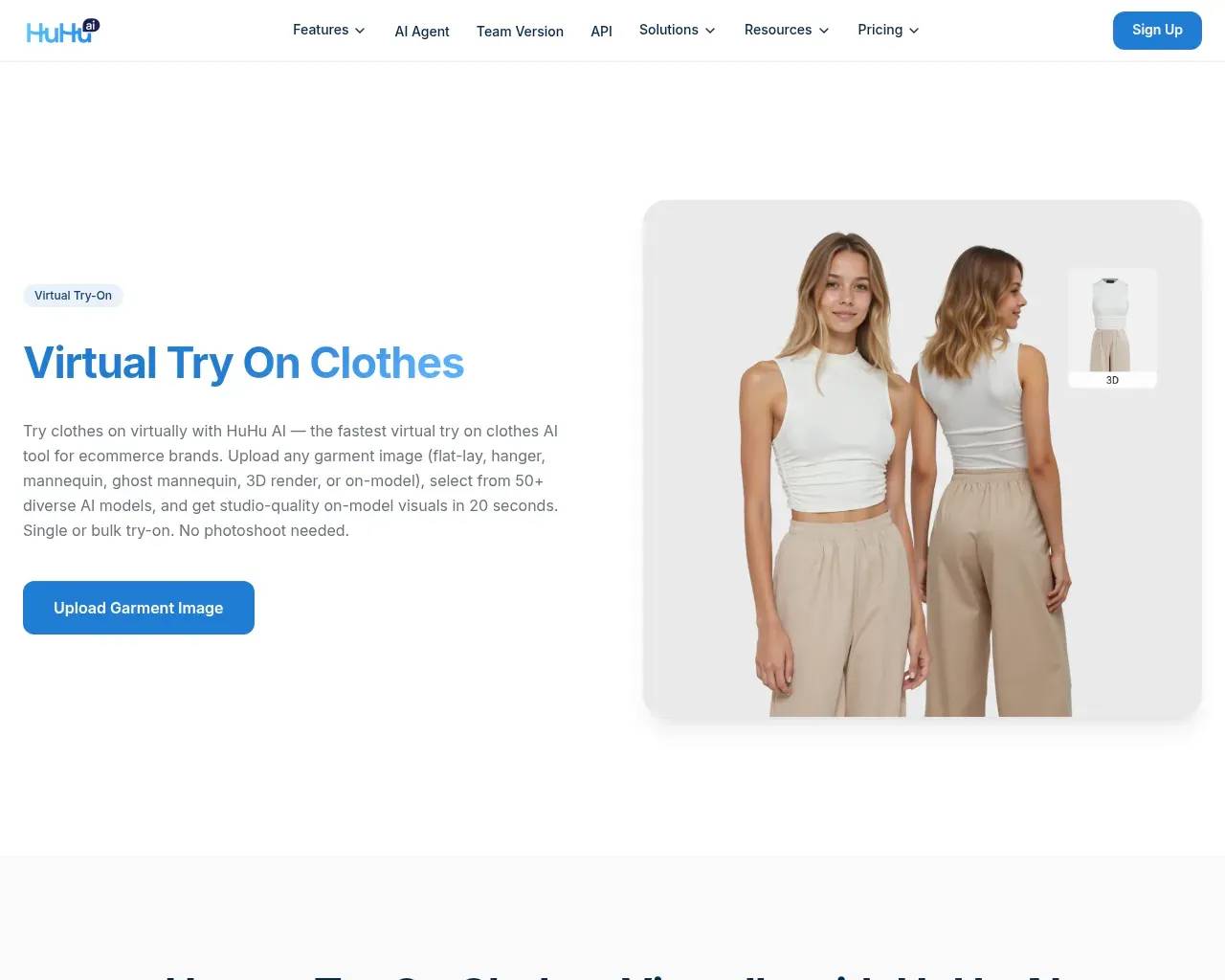
The part that's harder to replicate is the AI Fashion Model Generator. Rather than dropping clothes onto a fixed roster of stock faces, HuHu lets you build models by attribute — age, ethnicity, hair, body size, pose — and reuse them so a brand can keep one consistent "house model" across an entire catalog. The help center lists three routes to that: Model Attributes (build from scratch), Generate from Model (reuse a generated look in new poses and scenes), and Model Reference (copy the style and setting of an image you already like). For brands that care about representation, the inclusivity angle is explicit — plus-size, men's, kids', and varied skin tones are all advertised.
Around that core sits a long tail of point tools: a pose generator that spins multiple angles out of one photo, image-to-video, a ghost-mannequin converter, jewelry try-on, background changer, image upscaler, hand fixer, and a face swap, plus a "Product Avatar" feature that turns a product image into a talking, lip-synced UGC-style video ad. There's also an agentic layer HuHu calls the Ecommerce AI Agent — pitched as something that audits product pages and generates listing variations rather than just answering prompts — and integrations that matter for actual storefronts: a Shopify app and a try-on API.
Does it move the numbers?
This is where you have to read carefully. HuHu leans on case studies with named brands — most prominently SHEIN and Saks Fifth Avenue — and the figures are striking. The published SHEIN case study claims a 90% cut in photography costs, a 23.9% conversion uplift on AI-generated imagery versus traditional photos within three months, and time-to-market dropping from five days to under four hours across 100,000+ SKUs a month.
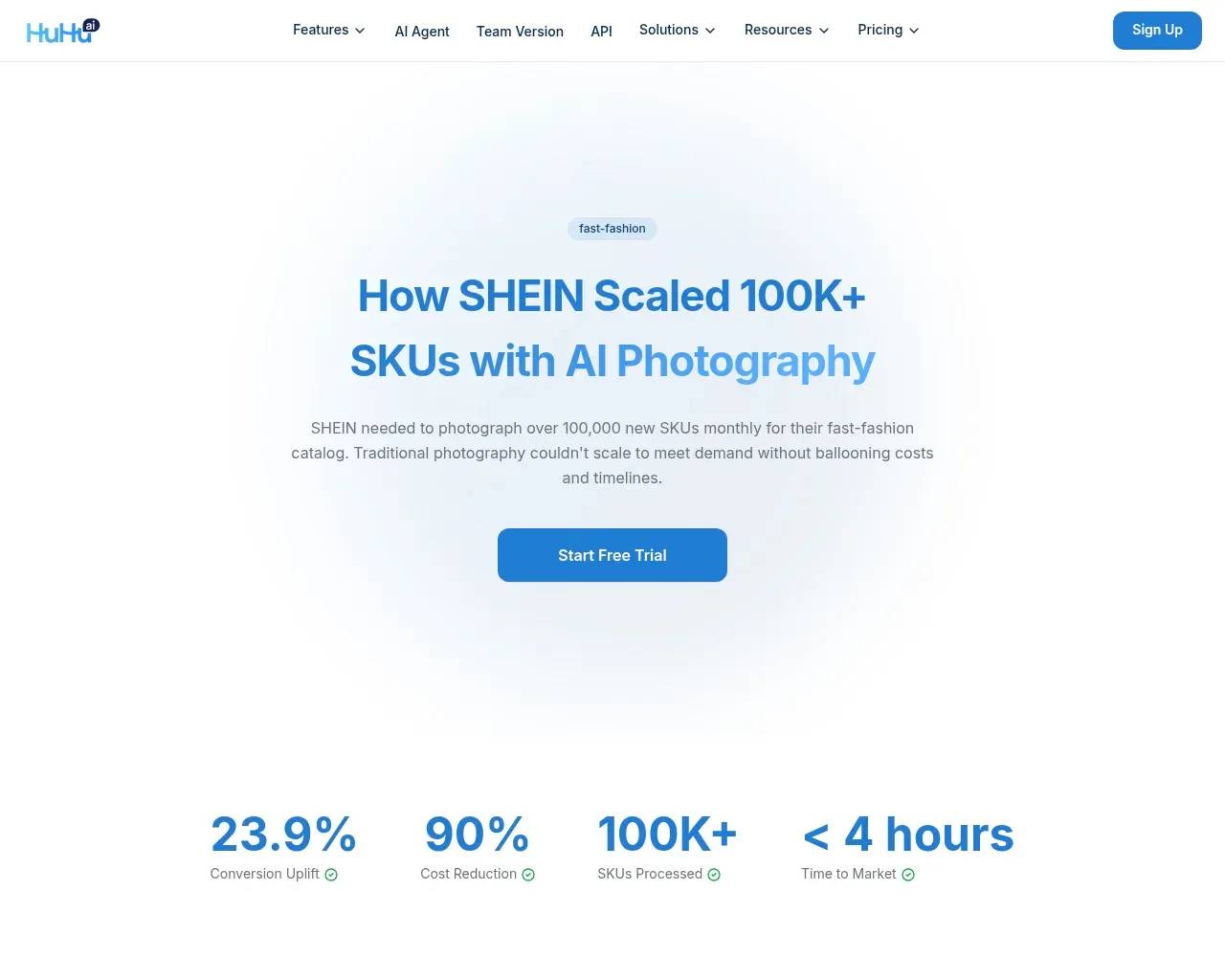
Treat those as vendor-published numbers, not independent benchmarks. They're plausible — bulk AI imagery is genuinely cheaper than studio days — but they're HuHu's own framing of HuHu's own results, and the customer testimonials on the homepage (a director citing a 70%+ cost cut, a creative lead saying a two-week shoot now takes 15 minutes) come from the same place. The honest read: the direction is credible, the exact percentages are marketing until your own catalog reproduces them.
What it costs
HuHu runs on a credit model where one credit roughly equals one generated image. Pricing is tiered: a Basic plan around $99/month for 100 images, Pro at $249 for 300, and Studio at $499 for 800, with all tiers including access to the full model library and general commercial-use terms. There's a steep promotional hook — a "LAUNCH90" code advertised at 90% off the first month, so that $499 Studio plan opens at roughly $49.90 before snapping to full price. Two details worth flagging before you commit: unused credits don't roll over month to month, and a free signup at app.huhu.ai lets you test try-on and model generation before paying. The separate Shopify app lists as free to install. Pricing this specific tends to drift, so confirm the current numbers on HuHu's own pricing page before budgeting.
Where the seams show
The single most grounding piece of independent feedback isn't flattering. On the Shopify App Store, HuHu's try-on app currently sits at a 1.0 rating from one review. The reviewer — a US store that had been running the app for nine months — wrote that it "either resizes the logo too big or changes the color," and didn't recommend it. One review is a thin sample, but it points at the realistic failure mode of generative try-on: brand-critical details like logos, prints, and exact color matching are exactly where AI image generation tends to slip. If your garments live or die on precise branding, plan to QA every output.
A couple of other caveats follow from how new this is. HuHu's Shopify app launched in mid-2025 and the company is a small US operation (Bellevue, Washington), so independent third-party reviews are genuinely sparse — I found no substantive Hacker News or Reddit discussion, which means most of the signal still comes from HuHu and listing sites. And the sticker price is real: once the first-month promo lapses, $99–$499 a month is a meaningful line item for a small brand still validating whether AI imagery converts for its products.
Who it's for
HuHu fits apparel brands, marketplace and third-party sellers, wholesale manufacturers, and fashion influencers who shoot at volume and feel the photography bottleneck most acutely — especially teams that want a consistent, diverse model roster without booking talent for every drop. It's a weaker fit if your catalog is small enough that occasional photoshoots are cheaper than a subscription, or if absolute fidelity on logos and color is non-negotiable and you can't spare time to review every generated frame.
The smart way in is the free tier: run your hardest garments — busy prints, branded pieces, tricky fabrics — through try-on and the model generator before you pay, and judge the output against your own product pages rather than someone else's case study.
FAQ
Do I need to write prompts? No. HuHu markets a no-prompt workflow — you upload garment images and choose models rather than describing scenes in text.
Will it match my exact brand colors and logos? Not reliably, based on available feedback. The one public Shopify review specifically flags logo sizing and color shifts, so treat brand-critical output as something to check, not trust blindly.
Can it do more than still images? Yes — it also generates poses, image-to-video, and talking "product avatar" video ads, and offers a try-on API and Shopify app for integrating into a live store.
Sources consulted
- HuHu AI homepage — product positioning, feature list (try-on, model generator, pose, video, product avatar, AI Agent), and customer testimonials.
- What is HuHu AI? — Help Center — official product description, the three model-generation methods, and target audience.
- SHEIN case study — vendor-published cost, conversion, scale, and time-to-market figures.
- Huhu: AI Model + Virtual Try-on on the Shopify App Store — independent rating and review, launch date, developer location, and app feature claims.
- HuHu AI reviews on Product Hunt — third-party listing confirming the product's public presence.
- HuHu AI sitemap (huhu.ai/sitemap.xml) — full feature/tool inventory, case-study and help-center coverage.
Published on: June 6, 2026
Looking for alternatives to HuHu AI? See all HuHu AI alternatives →
Have an AI tool of your own? Submit it below and get a free, in-depth product review article — just like this one.
Add your AI tool in seconds
Paste your URL and we'll draft the listing. You review and edit every field before submitting.