
SciSpace Review: An AI Research Assistant for Reading Papers Faster
By: AI Collection
At a glance

Scispace
PaidSciSpace Review: An AI Research Assistant for Reading Papers Faster
You have forty tabs open, each a PDF you half-understand, and a literature review due in two weeks. That scenario is exactly the one SciSpace is built for. It's an AI research assistant aimed at academics — students, PhDs, and working researchers — that promises to compress the slow parts of research: finding the right papers, parsing dense methods sections, and keeping citations straight.
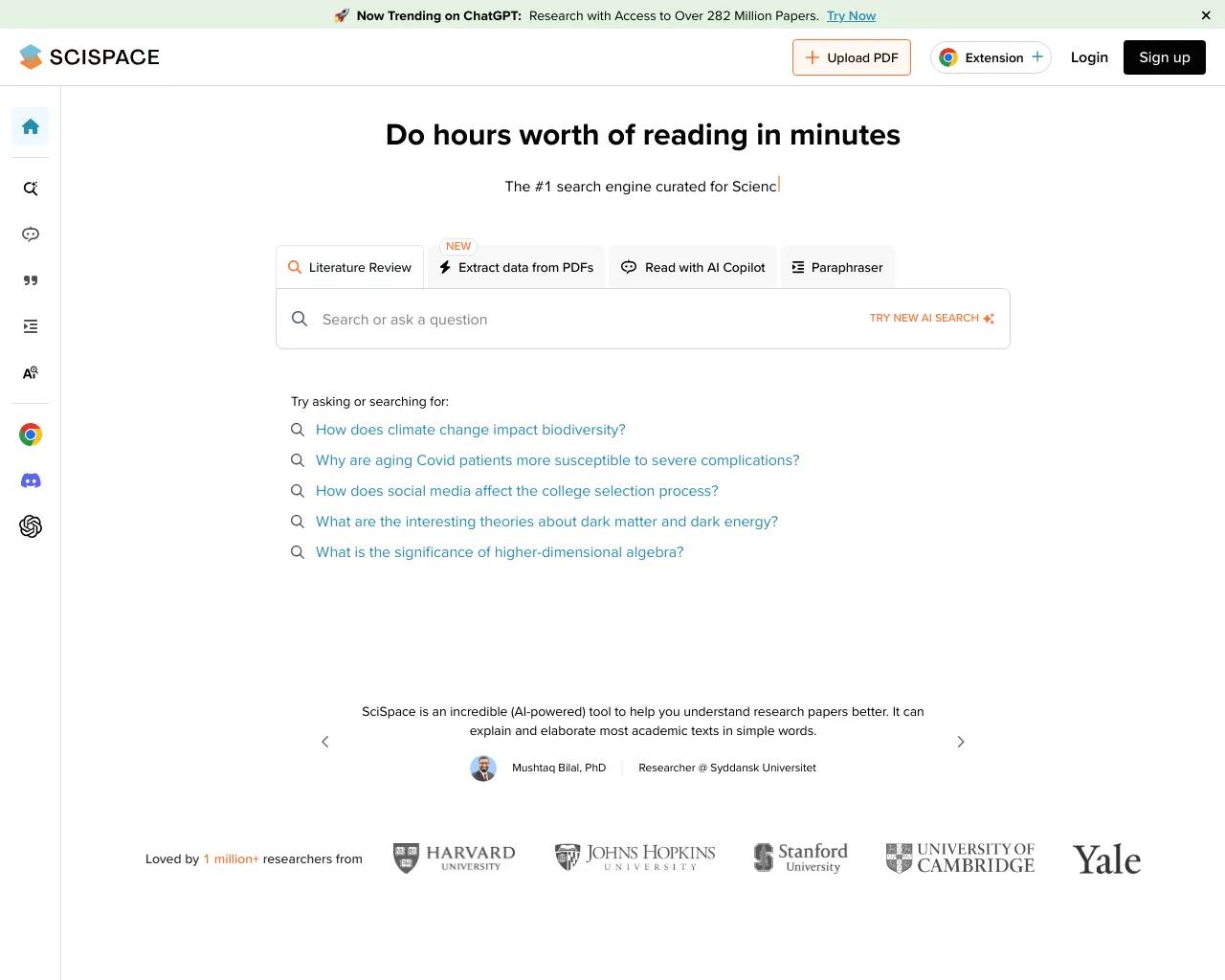
Built by PubGenius Inc. (and known for years under its old name, Typeset.io), SciSpace has grown into a fairly broad toolkit rather than a single feature. The pitch on its homepage is blunt: "do hours worth of reading in minutes." Whether it delivers depends a lot on how you use it — and on how carefully you check its output.
What it actually does
At its core, SciSpace sits on top of a large index — the company says 280M+ papers — and layers AI tools over it. A few pieces stand out:
- Chat with PDF. Upload a paper and ask it questions. Instead of a generic summary, answers come back linked to specific paragraphs and sections, so you can jump to the source text rather than taking the model's word for it.
- Literature review search. Run a query across the paper index and get back summaries, and in some cases an attempt to surface gaps — useful as a starting scaffold for a systematic review rather than a finished one.
- AI Writer. Drafting help for abstracts, sections, and structure, with the selling point that suggestions come with cited sources rather than free-floating prose.
- Citation generator. Paste a DOI or a title and get a formatted reference. SciSpace claims support for APA, MLA, Chicago and a very long tail of styles (2,300+ by their count).
- Odds and ends. A paraphraser, a data-extraction tool for pulling structured info out of PDFs, an AI-text detector, plus a Chrome extension and a mobile app so the copilot follows you onto journal pages and your phone.
There's also a "Research Agent" framing — a more autonomous mode meant to chain these tasks together and return citation-backed results — and a biomedical-specific agent for life-sciences work. SciSpace was an early mover here too: it shipped a ChatGPT plugin (ResearchGPT) back when those were new, which tells you the team tends to chase the frontier rather than sit still.
Where it earns its keep
The consistent praise across independent reviews and user feedback lands on the same handful of jobs: discovering papers you didn't know existed, interrogating a single PDF quickly, and pulling structured data out of studies. Reviewers repeatedly describe real time savings — the difference between an afternoon of skimming and twenty minutes of targeted questions.
The "explain this like I'm not a specialist" use case comes up a lot, and not only from academics. One Product Hunt commenter, a self-described layman, valued it for cutting through studies that get misrepresented elsewhere — a reminder that the tool's audience stretches beyond the lab. For a first pass on an unfamiliar field, that lowered barrier is genuinely the point.
The caveat you can't skip
Here's the part to take seriously before you trust it with your bibliography: verify the citations. A recurring complaint — across reviews and research-community chatter — is that SciSpace has at times produced references that don't hold up: nonexistent citations, wrong co-authors, off journal details, even a reference attributed to a user's own name. This isn't unique to SciSpace; it's the well-documented hallucination problem that haunts AI tools touching academic sourcing. But it matters more here because the entire value proposition is built on trustworthy references.
The practical takeaway isn't "avoid it." It's "treat its output as a fast draft, not a final source." Click through to the underlying paper. Confirm the DOI resolves. The citation-linking in Chat with PDF helps precisely because it points you back to real text — lean on the features that show their work, and double-check the ones that generate from scratch.
Other reported rough edges are milder: summaries can misread niche or domain-specific terminology (biotech terms get singled out), and the bundled AI detector — while reasonably strong on plain machine-written text — gets shaky on writing that mixes human and AI contributions, which is most real-world academic writing now.
Pricing, in broad strokes
SciSpace runs on a freemium model. There's a free tier to test the waters, a paid Premium subscription for unlimited access, and team and enterprise options above that. Billing toggles between monthly and yearly, with the yearly plan advertised at roughly 40% off, and the site offers a 24-hour money-back guarantee. Usage is metered through a credit system, with optional add-on credits.
That credit model is worth flagging, because it's where some users get frustrated: on lower tiers the credit ceiling can arrive faster than expected, and a few reviewers noted the billing wasn't as transparent as they'd like. (Exact prices shift and are best read straight off the pricing page before you commit — they weren't legible from the static page at the time of writing.) If you're a heavy daily user, price out the annual Premium plan rather than assuming the free tier will carry you.
Who it's for
SciSpace fits best if you regularly read papers outside your specialty, run literature reviews, or need a fast way to extract and compare findings across many studies — and if you're disciplined about checking sources. Students ramping up on a new topic and researchers triaging a large reading pile will get the most out of it. The trust logos it cites (researchers from the likes of Harvard, Stanford, and Cambridge) and a stated 1M+ user base suggest it has traction in exactly that crowd.
It's a weaker fit if you need airtight citations with zero manual verification, or if your work lives in a narrow technical domain where the summaries are most likely to stumble. In those cases it's still a useful reading aid — just not an autopilot.
A quick verdict
SciSpace is one of the more capable AI research assistants available, and the breadth is real: search, reading, extraction, writing, and citation tooling under one login. The honest framing is that it's a powerful accelerator with a sharp edge — it speeds up the reading and the first draft, but the citation reliability means you stay in the loop. Used that way, it earns its place in a researcher's toolkit.
FAQ
Is there a free version? Yes — there's a free tier, with paid Premium, team, and enterprise plans above it and a 24-hour money-back guarantee on paid plans.
Can I trust its citations? Treat them as a starting point. Reviewers have reported fabricated or inaccurate references, so verify any citation against the original source before you use it.
What was Typeset.io? It's SciSpace's former name. The product is run by PubGenius Inc. and rebranded to SciSpace.
Does it work inside the browser? Yes — there's a Chrome extension and a mobile app in addition to the web tools.
Sources consulted
- SciSpace homepage — product positioning, tool lineup, "280M+ papers" and "1M+ researchers" claims, and trust logos.
- SciSpace llms.txt — first-party descriptions of Chat with PDF, literature review search, AI Writer, citation generator (2,300+ styles), paraphraser, and AI detector.
- SciSpace pricing page — freemium structure, yearly discount, 24-hour guarantee, credit system, and user testimonials.
- Hacker News (Algolia) — SciSpace — the ResearchGPT ChatGPT plugin and the Typeset.io → SciSpace paid-subscription history.
- The Effortless Academic — SciSpace 2025 review — independent assessment of literature-review strengths and limitations.
- Scispace reviews on Capterra — verified user pros and cons, including citation-accuracy and credit-limit concerns.
- Typeset/SciSpace reviews on Product Hunt — early user reactions and the "explain it simply" use case.
Published on: June 3, 2026
Looking for alternatives to Scispace? See all Scispace alternatives →
Have an AI tool of your own? Submit it below and get a free, in-depth product review article — just like this one.
Add your AI tool in seconds
Paste your URL and we'll draft the listing. You review and edit every field before submitting.
More Product Reviews:

By: AI Collection