
Dynamiq Review: An Open-Source Agent Framework and On-Prem GenAI Platform
By: AI Collection
At a glance

Dynamiq
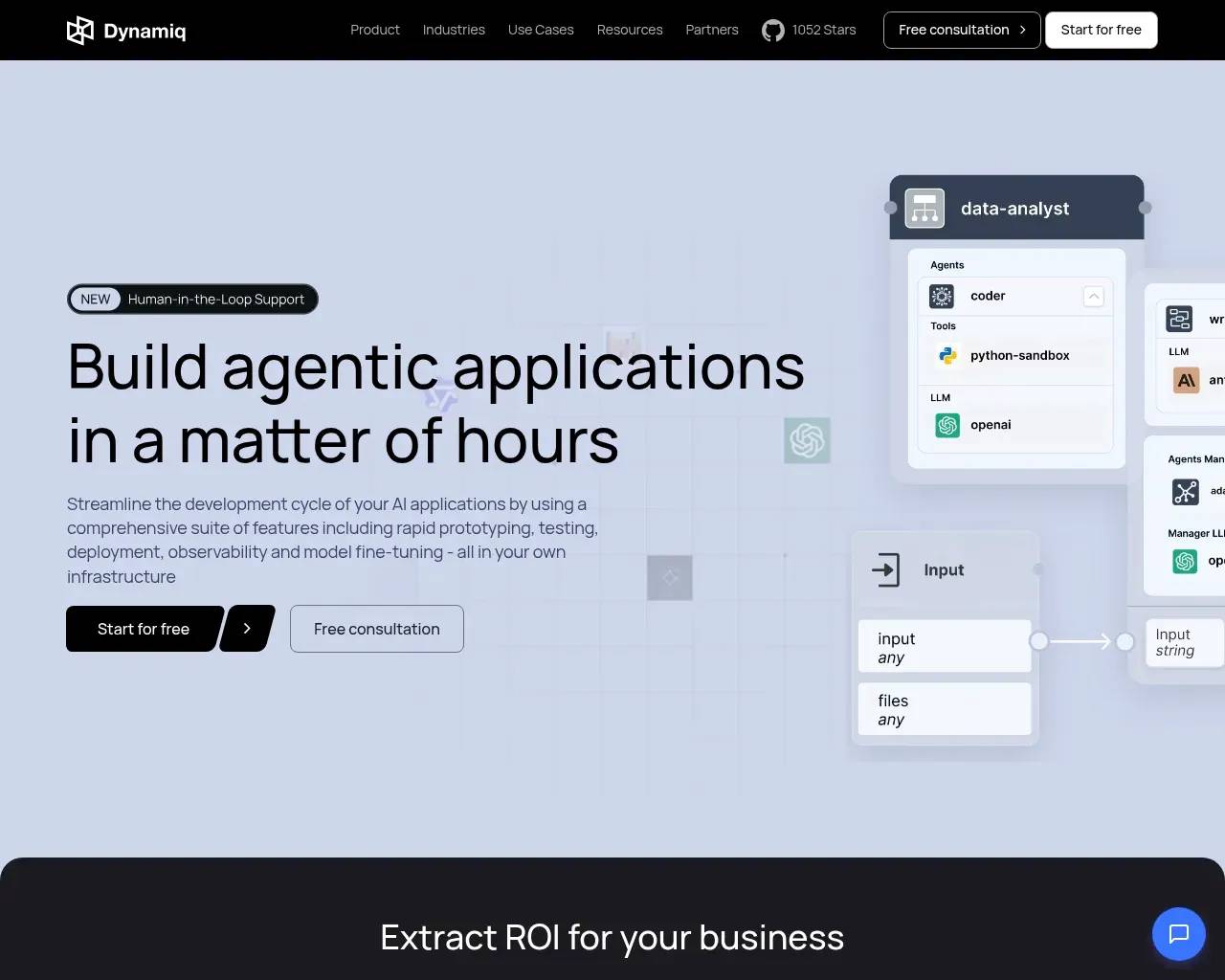
PaidThere are really two things called Dynamiq, and figuring out which one you need is the first decision a buyer has to make. One is an open-source Python framework you pip install and wire together in code. The other is a commercial, low-code platform that wraps the same ideas in a browser UI and sells the enterprise story around it — on-premise deployment, guardrails, governance. They share a name, a team, and a worldview, but they are aimed at different people. This review walks through both, what holds up, and where I'd want to test before committing.
The open-source framework: agents and RAG, assembled in code
The free, Apache-2.0 framework lives at github.com/dynamiq-ai/dynamiq. It's been public since September 2024, sits around 1,050 stars and 128 forks, and — checking the repo — was last pushed within a day of writing, so it's not abandonware. Installation is the usual one-liner:
pip install dynamiq
The mental model is nodes and workflows. An LLM call is a node. An agent is a node with a role, a model, tools, and a max_loops cap. A Workflow strings nodes together and runs them in parallel where it can, or sequentially when you declare a NodeDependency and pipe one agent's output into the next. The README ships runnable examples for the patterns you'd expect: a ReAct agent wired to an E2B code interpreter, two agents running in parallel, a manager agent that delegates to research and writer sub-agents, a memory-backed chatbot, and a graph orchestrator with states, edges, and conditional routing for flows that need to loop back on themselves.
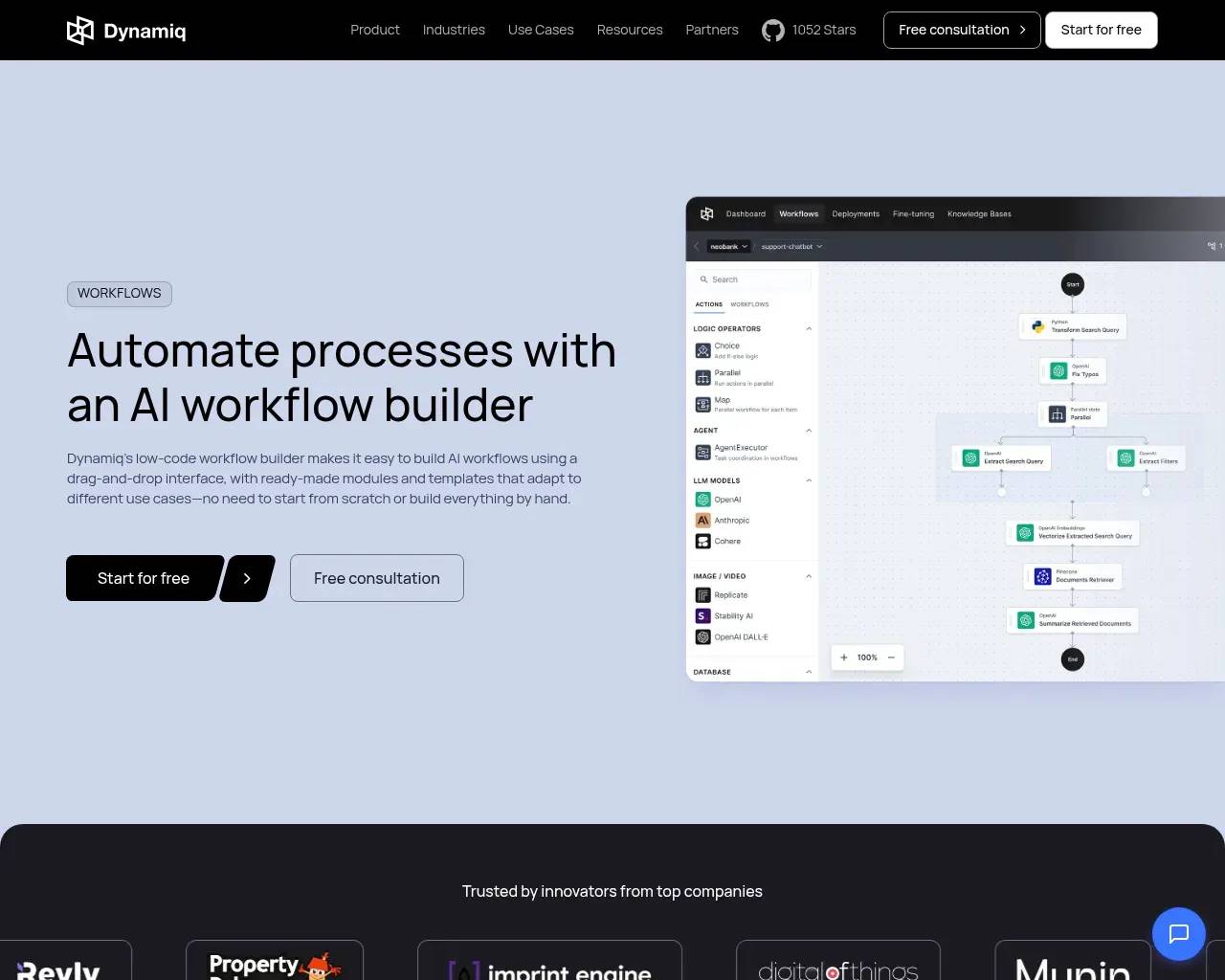
RAG is treated as a first-class workflow rather than a bolted-on feature. The indexing example converts PDFs, splits them, embeds with OpenAI, and writes to a Pinecone index; the retrieval side embeds the query, pulls matching documents, and feeds them into a prompt for answer generation. None of this is novel on its own — LangChain, LlamaIndex, and CrewAI cover similar ground — but having indexing, retrieval, agents, and multi-agent orchestration expressed in one consistent node API is genuinely convenient. Python 3.10+ is required, and the hosted docs carry more examples than the README.
One honest note on traction: the framework's Show HN launch in October 2024 drew only 7 points and a single comment. The star count is respectable, but this isn't a tool with a loud community behind it yet. If you adopt the framework, budget for reading source code when the docs run out.
The platform: the same ideas, minus the code
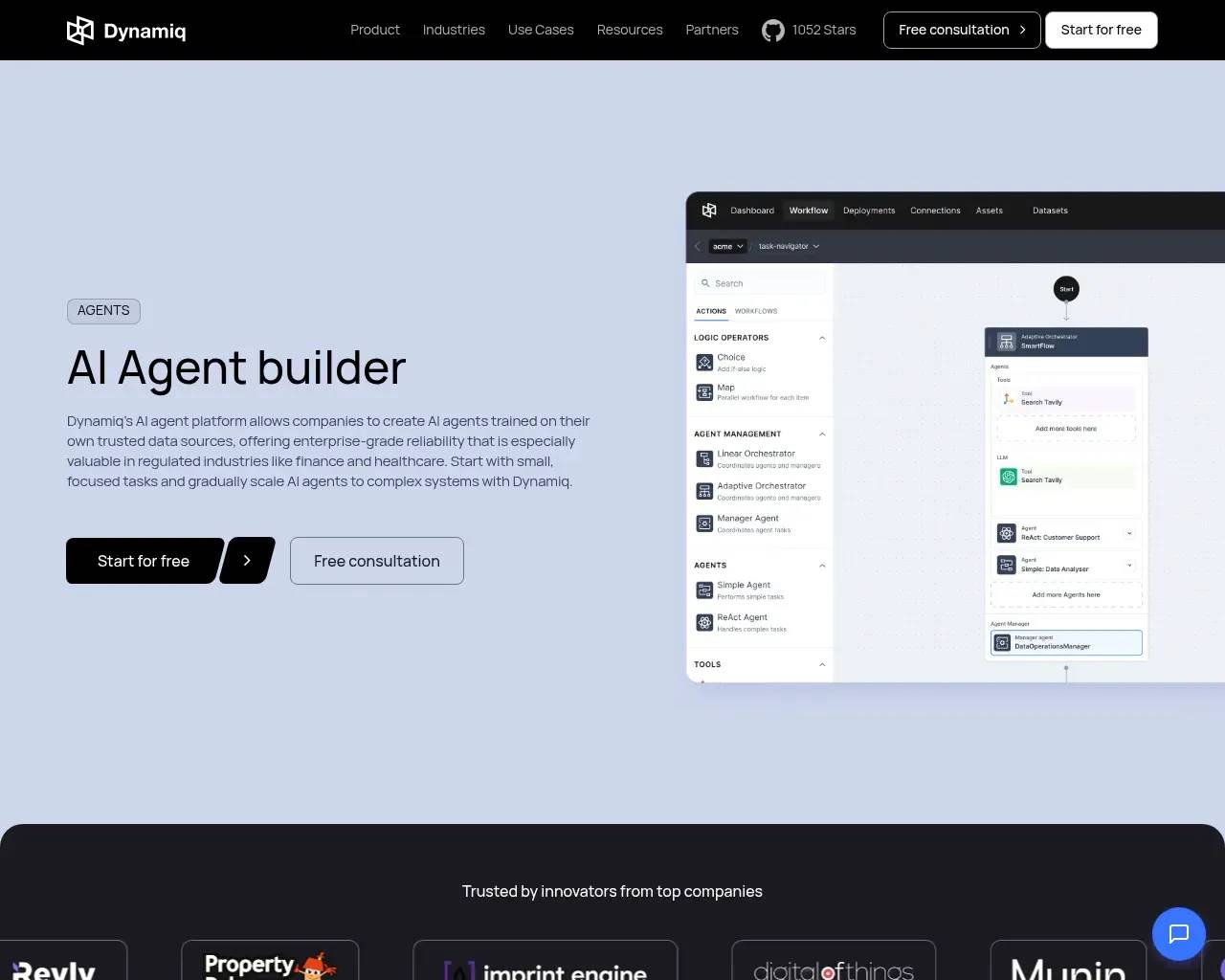
The commercial side at getdynamiq.ai is where the pitch sharpens. It's a low-code builder for the same primitives — Agents, Workflows, Knowledge RAG — plus the operational layer that teams actually fight over in production: Observability for logging every interaction, Evaluations, Guardrails, Fine-Tuning of open-source LLMs on private data, and a shared Collaboration workspace with company-wide guardrails.
The deployment angle is the real differentiator. Dynamiq leans hard on running inside your own infrastructure — on-premise or private cloud — so data and any open-source models stay under your control. That framing is aimed squarely at regulated buyers, and the site's industry pages back it up with Financial Services, Healthcare, and Public Sector. There's also a partnership with IBM, including deployability on IBM Cloud and a presence in the watsonx Orchestrate agent catalog, which is a meaningful trust signal for enterprise procurement.
The marketing makes some big numerical promises — avoiding a $600k in-house MLOps hire, collapsing six-month build cycles to hours, cutting compliance costs 30–50% with on-prem deployment. Treat those as vendor claims, not benchmarks; they're the kind of figures that depend entirely on what you were doing before. More concretely, Dynamiq's own case studies describe a digital bank in Asia automating roughly 85% of customer-support inquiries with an agent built and deployed in about 30 days. That's vendor-reported too, but it's specific enough to ask about in a demo.
Pricing: start free, then talk to sales
Pricing is the least transparent part. The framework is free under Apache-2.0. The platform offers a "Start for free" entry point and a free consultation, but there is no public pricing table for the enterprise tiers — like most on-prem GenAI vendors, anything serious routes through a quote. Independent listings corroborate this: public pricing is limited and enterprise buyers request a custom quote. If predictable, self-serve pricing matters to you, factor in the back-and-forth.
Where it fits — and where it doesn't
Dynamiq is a good fit for an engineering-led team at a company that can't ship customer data to a third-party API and wants one place to build, evaluate, observe, and govern agentic apps in its own environment. The open-source framework is a low-risk way to prototype that thesis before paying for anything.
The trade-offs are the ones you'd predict for a platform at this stage, and independent reviewers flag the same set. The library of pre-built integrations is smaller than mature automation tools like Zapier or Make, so check that your specific connectors exist before you commit. The more powerful features assume real technical fluency — this is not a no-code tool for non-engineers, despite the low-code label. Documentation and community are improving but aren't yet at the scale of the larger frameworks. And the quote-based pricing means you can't easily benchmark cost against alternatives without a sales conversation.
None of those are dealbreakers; they're the normal cost of betting on a younger, on-prem-first platform rather than a commoditized SaaS. The thing that makes Dynamiq worth a look is the combination most competitors split apart: an open-source framework you can read and run today, and a governed platform that deploys where your data already lives. If on-premise control is a hard requirement, that pairing is the reason to put it on the shortlist — then pressure-test the integrations and pricing before you sign.
Sources consulted
- Dynamiq homepage — product surface, on-prem positioning, ROI claims, "start for free"
- dynamiq-ai/dynamiq on GitHub — license, stars/forks, creation date, maintenance activity, install steps, and the agent/RAG/workflow code examples
- Dynamiq documentation — referenced for deeper framework guides
- Dynamiq sitemap — product, industry, use-case, and IBM-partnership page structure
- Show HN: Dynamiq (Hacker News) — launch reception and community traction signal
- Dynamiq Review — autoaireview.com — independent take on features, the bank case study, and limitations
- Dynamiq — AI Agents Directory — independent feature/limitation summary and pricing transparency note
Published on: June 9, 2026
Looking for alternatives to Dynamiq? See all Dynamiq alternatives →
Have an AI tool of your own? Submit it below and get a free, in-depth product review article — just like this one.
Add your AI tool in seconds
Paste your URL and we'll draft the listing. You review and edit every field before submitting.
More Product Reviews:
By: AI Collection