
ScoreDetect Review: Blockchain Timestamping as Proof of Ownership
By: AI Collection
At a glance

ScoreDetect
PaidScoreDetect Review: Blockchain Timestamping as Proof of Ownership
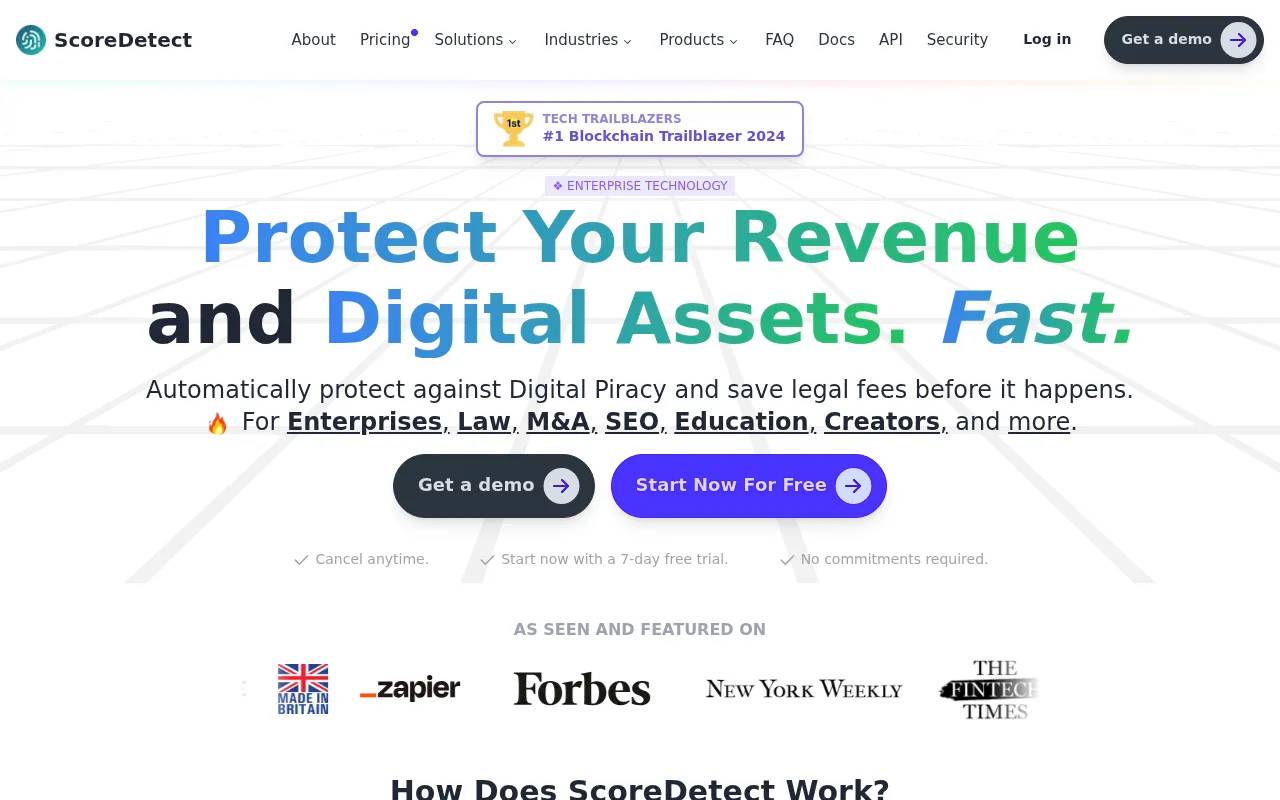
You publish a photo essay, a long-form guide, or a product launch page. Weeks later it turns up on someone else's site with their name on it. Proving you made it first — convincingly, quickly, without a lawyer — is harder than it should be. ScoreDetect is built around that exact problem: it creates a tamper-evident, timestamped record that a specific piece of content existed, in a specific form, at a specific moment.
How it actually works
The mechanism is more restrained than "blockchain" marketing usually implies, and that's a point in its favor. When you submit content, ScoreDetect generates a checksum — a digital fingerprint — of the file or text and writes that fingerprint to a blockchain. Per the company's own FAQ, it does not store your files or content at all; only the checksum lives on-chain, so your actual work never leaves your hands. You get back a verification certificate that anyone can later check against the original.
It runs on SKALE, an Ethereum layer-2 network the site describes as eco-friendly with zero gas fees — a sensible choice, since per-transaction cost and energy use are the usual objections to putting anything on a blockchain. The pricing page lists certificate creation at roughly 3,000 milliseconds, so in practice you click and the proof exists a few seconds later.
What stands out
A few things lift it above a generic "timestamp your file" utility:
- An open-source WordPress plugin. ScoreDetect's WordPress timestamping plugin is its most visible distribution channel — a Show HN post frames it as open-source, and the homepage leans on it heavily. For anyone running a WordPress blog, automatic timestamping at publish time is the lowest-friction version of this idea.
- Formal recognition certificates. Beyond the raw on-chain record, you can export a designed certificate (PDF, single or bulk) carrying the copyright owner's name, additional owners, a signature, and file details — the kind of document that's actually useful to hand a client or attach to a dispute.
- Integrations and an API. It connects to 7,000+ apps through Zapier and exposes a developer API, so timestamping can be wired into an existing publishing workflow instead of living as a separate manual chore.
- An SEO angle. The product pitches timestamping plus Schema.org structured data and trust widgets as a way to reinforce Google's E-E-A-T signals. Treat that as a secondary benefit rather than a guarantee, but the structured-data output is concrete.
What it costs

Pricing is refreshingly cheap for what it is. The Pro plan starts at about $11.31/month billed yearly, on a 7-day free trial, and includes 100 verification certificates per month; beyond that you pay roughly $0.1131 per certificate, up to a 200,000-certificate lifetime ceiling before you're nudged to Enterprise. Pro also covers unlimited websites, the WordPress plugin, PDF exports, and API access.
The Enterprise tier (custom pricing, demo-gated) is where the heavier protection sits: 24/7 content and brand monitoring, invisible watermarking for images, video, audio and documents, automated takedown notifications, SSO, white-labeling and a custom domain. ScoreDetect's own comparison table claims rival tools average around $1,860/month for similar capability — a self-reported figure, so weigh it accordingly, but the entry price is genuinely low.
Who it's for
ScoreDetect fits content creators, bloggers, photographers, agencies and SaaS teams who want a cheap, fast, defensible record that they published something first — especially WordPress users who can automate it. If your concern is "I need provenance for my work and a clean certificate to show for it," the Pro plan handles that well. If your concern is "I need someone to find and remove stolen copies of my work," that's the Enterprise feature set, and you should budget for it as such.
The honest caveats
A balanced look has to flag a few things, and to the company's credit some of them come straight from its own documentation:
- It's proof, not enforcement (on Pro). A certificate establishes that content existed at a point in time. It doesn't detect infringement or remove copies — proactive monitoring and takedowns are Enterprise-only. Don't expect the entry plan to police the web for you.
- Legal standing varies. The FAQ states plainly that a certificate's legal weight "may vary by jurisdiction" and is best used alongside other safeguards. Blockchain timestamps are useful supporting evidence, not a replacement for formal copyright registration where that matters.
- Timestamping is a commodity. Services such as OriginStamp do the same core thing — ScoreDetect even publishes an "OriginStamp alternative" page. The real differentiators here are the WordPress plugin, the certificate experience, and the price, not the underlying concept.
- Third-party validation is thin. Most testimonials live on ScoreDetect's own site, and its Show HN posts drew little discussion. The open-source plugin is a genuine transparency signal, but there isn't yet a deep bench of independent reviews to lean on.
Bottom line
ScoreDetect is a well-scoped, honestly-pitched tool: it makes timestamped proof-of-ownership cheap and nearly instant, and it's candid about what that proof does and doesn't guarantee. For WordPress publishers and creators who want provenance without overhead, the free trial is an easy thing to try. Just go in clear-eyed that the entry plan proves authorship — it doesn't chase down the people who ignore it.
Sources consulted
- ScoreDetect homepage — product positioning, the checksum/SKALE mechanism, FAQ, and feature claims
- ScoreDetect pricing — Pro/Enterprise tiers, per-certificate cost, and the competitor-cost claim
- Hacker News (Algolia search) — community traction and the open-source WordPress plugin signal
- Internet Archive Wayback Machine — confirms the site's archived history
Published on: May 31, 2026
Have an AI tool of your own? Submit it below and get a free, in-depth product review article — just like this one.
Add your AI tool in seconds
Paste your URL and we'll draft the listing. You review and edit every field before submitting.

